Introduction
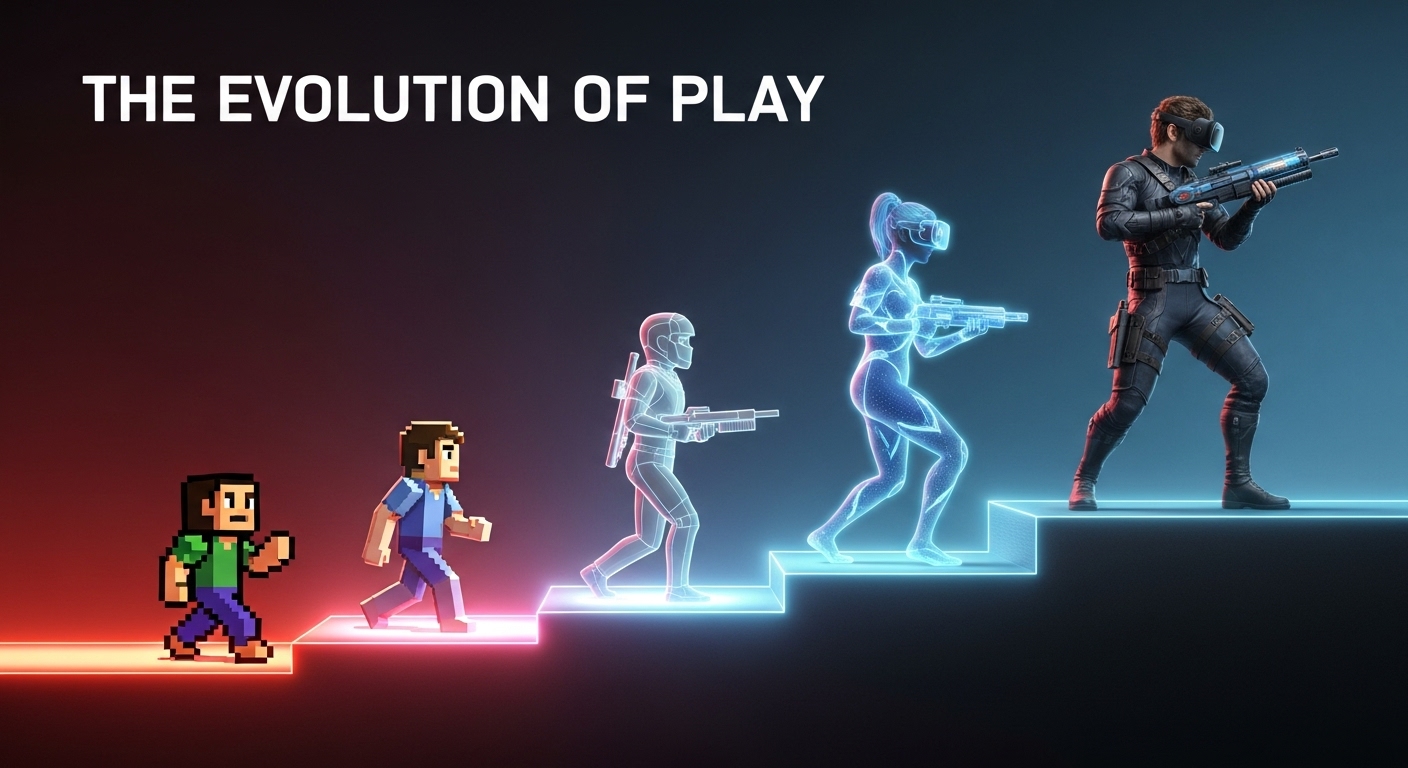
Gaming is no longer just a pastime; it has evolved into one of the most dynamic and influential industries in modern entertainment. What began as simple blocks of color moving across a screen has transformed into a multi-billion-dollar universe of storytelling, competition, and creativity. The journey from the days of Pong and Tetris to open-world adventures and virtual reality has been nothing short of revolutionary.
This blog explores the fascinating evolution of gaming — from its humble beginnings to the complex, interactive ecosystems we experience today. It also delves into how gaming impacts culture, technology, and human connection.
The Birth of Video Games
The story of gaming began in the mid-20th century, long before consoles and gaming PCs became household staples. Early computer scientists and engineers were fascinated by the idea of using machines to simulate play. In 1958, physicist William Higinbotham created Tennis for Two, a simple tennis simulation displayed on an oscilloscope. Just a few years later, in 1962, MIT students developed Spacewar!, one of the first digital computer games.
These early creations were more experiments than entertainment products, but they laid the foundation for the industry to come. The 1970s brought about a significant breakthrough with the release of Pong by Atari, which became a commercial success and introduced the concept of arcade gaming to the public.
The Golden Age of Arcades
The late 1970s and early 1980s are often called the “Golden Age of Arcades.” During this period, gaming became a cultural phenomenon. Arcades were filled with bright lights, beeping sounds, and the intense energy of competition. Games like Pac-Man, Space Invaders, and Donkey Kong captured the imagination of millions.
This era wasn’t just about high scores — it was about community. Friends gathered after school or work to challenge each other, sharing a space where skill and reflexes ruled. The arcade became a social hub for a generation, and it established the foundation for what would later become the multiplayer culture of gaming.
The Rise of Home Consoles
As technology advanced, the dream of playing video games at home became a reality. The release of the Atari 2600 in 1977 was a game-changer. For the first time, players could insert cartridges and choose from a variety of titles, giving birth to the concept of a gaming library.
The early 1980s saw a boom in home gaming, but it wasn’t without setbacks. In 1983, the video game industry suffered a major crash due to market saturation and low-quality titles. Many believed gaming was a fad destined to fade away.
Then came Nintendo.
With the release of the Nintendo Entertainment System (NES) in 1985, gaming experienced a rebirth. Titles like Super Mario Bros., The Legend of Zelda, and Metroid set new standards for creativity, storytelling, and gameplay design. The NES not only saved the industry but also established Nintendo as a dominant force in gaming for decades to come.
The 16-Bit Revolution
The late 1980s and early 1990s brought about fierce competition in the gaming market. Sega entered the scene with its Genesis console, challenging Nintendo’s dominance. The so-called “console wars” between Sega and Nintendo pushed both companies to innovate rapidly.
This era saw the rise of 16-bit graphics, allowing for richer visuals and smoother animations. Games like Sonic the Hedgehog, Super Mario World, and Street Fighter II became global sensations. The concept of branding, mascots, and franchise identity took hold — Sonic vs. Mario wasn’t just a marketing gimmick; it was a cultural showdown.
Beyond graphics, this period marked the beginning of storytelling as a major element in gaming. Titles such as Final Fantasy VI and Chrono Trigger demonstrated that games could offer emotional narratives and deep character development, rivaling movies and literature in their storytelling power.
The Dawn of 3D Gaming
The mid-1990s introduced the next great leap — the transition from 2D to 3D. The introduction of powerful hardware like the Sony PlayStation, Nintendo 64, and Sega Saturn made it possible to create expansive 3D worlds.
Gamers will never forget the first time they played Super Mario 64. The freedom of movement, the ability to explore in three dimensions, and the sense of immersion were revolutionary. Similarly, titles like Tomb Raider, Final Fantasy VII, and Metal Gear Solid showcased how 3D graphics could enhance storytelling and gameplay in profound ways.
The 1990s also marked the birth of gaming franchises that continue to thrive today. Resident Evil introduced survival horror, Gran Turismo brought realism to racing, and The Legend of Zelda: Ocarina of Time set the gold standard for adventure games.
The Online Gaming Era
As the internet became a household necessity in the late 1990s and early 2000s, gaming entered a new dimension — connectivity. Multiplayer gaming was no longer confined to split screens and local matches; now, players could connect across cities, countries, and continents.
Games like Quake, Counter-Strike, and StarCraft helped establish online communities and competitive gaming. The concept of “clans” and “guilds” emerged, bringing a social structure to gaming that mirrored real-world teamwork and collaboration.
Massively multiplayer online role-playing games (MMORPGs) like World of Warcraft changed the landscape entirely. Players were no longer just consumers; they became part of living, breathing virtual worlds. Entire economies, friendships, and even relationships were formed within these digital realms.
The Age of High Definition and Realism
By the mid-2000s, gaming had entered its most visually impressive phase yet. The Xbox 360, PlayStation 3, and powerful gaming PCs brought high-definition graphics to the mainstream. Games became cinematic, blending photorealistic visuals with voice acting, motion capture, and complex storytelling.
Titles like The Elder Scrolls V: Skyrim, Grand Theft Auto V, and The Last of Us blurred the line between film and gameplay. Developers pushed the boundaries of what games could express, exploring mature themes such as morality, loss, and survival.
This era also saw the rise of indie games, as digital distribution platforms allowed smaller studios and solo developers to reach global audiences. Games like Braid, Undertale, and Celeste reminded players that creativity and heart could sometimes outshine massive budgets.
The Birth of Esports
What began as friendly competition in arcades had now evolved into a global industry — esports. Professional gaming became a legitimate career, with tournaments drawing millions of viewers and offering prize pools rivaling traditional sports.
Games such as League of Legends, Dota 2, Counter-Strike: Global Offensive, and Fortnite helped establish esports as a mainstream spectacle. Dedicated arenas, sponsorship deals, and professional teams transformed gaming from a hobby into a profession.
Streaming platforms gave rise to gaming celebrities who built massive audiences by showcasing their skills, humor, and personalities. The line between player and performer blurred, creating a new kind of entertainment that thrives on interaction and authenticity.
The Social Power of Gaming
Beyond entertainment, gaming has become a powerful social force. Online platforms allow players from around the world to connect, communicate, and collaborate. Gaming communities have become safe spaces for creativity, expression, and belonging.
Cooperative titles such as Minecraft, Among Us, and Animal Crossing: New Horizons have shown that gaming isn’t just about competition — it’s also about creation and connection. During global challenges like the pandemic, games became vital tools for maintaining social bonds and emotional well-being.
Gaming has also proven to be an effective educational and therapeutic tool. Simulation and strategy games enhance problem-solving skills, while virtual reality experiences are used in medical training, physical therapy, and mental health treatment.
The Rise of Virtual and Augmented Reality
One of the most exciting frontiers in gaming today is the rise of virtual reality (VR) and augmented reality (AR). With devices like the Oculus Quest, PlayStation VR, and others, players can step inside their favorite worlds and experience them in ways previously unimaginable.
VR gaming provides a level of immersion that makes the player feel like they are truly inside the game. Whether it’s exploring alien worlds, painting in 3D space, or engaging in realistic combat simulations, VR pushes the boundaries of sensory engagement.
AR, on the other hand, blends digital content with the real world. Games like Pokémon GO proved how powerful AR can be in encouraging physical movement and real-world exploration. The possibilities for the future are endless — imagine role-playing games that unfold across your neighborhood or strategy games that overlay your environment in real time.
The Mobile Gaming Revolution
While consoles and PCs often steal the spotlight, mobile gaming has quietly become the most accessible and profitable sector of the industry. Smartphones turned gaming into a global phenomenon that transcends age, gender, and location.
From casual titles like Candy Crush and Clash of Clans to deep experiences like Genshin Impact, mobile gaming has evolved far beyond its humble beginnings. Today, mobile platforms offer console-level graphics, multiplayer functionality, and even cross-platform play.
This democratization of gaming means that everyone, from a teenager on a bus to an adult on a lunch break, can be part of the gaming world. Mobile gaming has redefined what it means to be a gamer — it’s no longer about the device, but the experience.
Storytelling and Emotional Depth
One of the most profound transformations in gaming is the emphasis on narrative and emotional depth. Games are no longer just about achieving high scores; they are about experiences, choices, and consequences.
Titles like The Witcher 3: Wild Hunt, Red Dead Redemption 2, and Life is Strange have demonstrated that games can tell complex, emotional stories that rival cinema. Players are not passive observers — they are participants who shape the story through their actions and decisions.
This interactivity creates a level of immersion unmatched by other forms of media. When a player makes a choice that alters a character’s fate or witnesses the consequences of their actions, the emotional connection becomes deeply personal.
Gaming and Technology: A Symbiotic Relationship
The growth of gaming has often driven technological innovation. Faster processors, better graphics cards, and advanced sound design have all been fueled by the demands of gamers seeking richer experiences.
Artificial intelligence has also begun to play a larger role, from creating more lifelike non-player characters (NPCs) to generating dynamic environments that adapt to the player’s behavior. Cloud gaming technology allows users to stream high-end games without needing expensive hardware, breaking down economic and accessibility barriers.
The relationship between gaming and technology is circular — as one advances, the other evolves alongside it, each pushing the boundaries of possibility.
Cultural Impact and Representation
Gaming today is more than entertainment; it is a reflection of society. Developers increasingly focus on representation, inclusivity, and diverse storytelling. Characters now come from various backgrounds, cultures, and identities, allowing players to see themselves in the worlds they explore.
Moreover, games have become platforms for cultural expression. Titles based on mythology, history, and folklore bring lesser-known stories to global audiences. From Norse legends in God of War to Japanese spirituality in Ghost of Tsushima, gaming bridges cultural gaps in ways traditional media cannot.
The artistic merit of gaming is also gaining recognition. Museums, film festivals, and universities now treat video games as legitimate forms of art — combining visual design, music, storytelling, and interactivity in a single medium.
The Future of Gaming
The future of gaming is bright, limitless, and continually evolving. Artificial intelligence, cloud computing, and immersive technology will redefine how games are created and experienced.
Imagine games that evolve based on your play style, stories that adapt to your emotions, or virtual worlds populated by AI-driven characters with genuine personalities. The line between the digital and physical worlds will continue to blur, giving rise to experiences that feel more like alternate realities than entertainment.
Accessibility will also improve, allowing people with disabilities to engage fully through adaptive controllers, voice commands, and innovative design. Gaming will continue to break barriers — socially, economically, and creatively.
Conclusion
From the flickering pixels of the 1970s to the breathtaking virtual worlds of today, gaming has transformed into an art form that defines a generation. It’s not just about entertainment; it’s about connection, creativity, and exploration.
Gaming brings people together across continents, languages, and cultures. It inspires innovation, tells unforgettable stories, and challenges our imagination. Whether you’re a casual player or a lifelong enthusiast, gaming is more than just a hobby — it’s a shared human experience that continues to shape the world in profound ways.
The journey of gaming is far from over. With every technological breakthrough, creative vision, and passionate community, the next chapter promises to be even more extraordinary. The question is no longer where gaming has been — but where it will take us next.